Sitting Too Much: How This Daily Habit Shortens Lifespan

Sitting too much has quietly become one of the most common daily habits of modern life. For many adults, especially after forty, long hours at a desk, in a car, or on the couch feel unavoidable. Work demands it. Convenience encourages it. Fatigue normalizes it. And because sitting rarely causes an immediate “alarm bell,” it can seem harmless — even restful.
But over the past two decades, research has increasingly treated prolonged sitting as its own health behavior, not simply “the absence of exercise.” Evidence suggests that long, uninterrupted sitting may be associated with changes in metabolism, circulation, muscle function, and cardiometabolic risk — sometimes even in people who meet weekly exercise targets. The goal here is not fear. It’s clarity. If longevity is built from daily habits, sitting is one of the habits worth understanding.
the quiet cost of modern comfort

Humans were not designed to stay in one posture for most of the day. Historically, daily life involved frequent transitions: standing, walking, carrying, squatting, and changing position. Today, many routines compress movement into small windows — a short workout, a quick errand — while most waking hours happen seated.
The body adapts to what it repeatedly experiences. When sitting dominates the day, the systems that thrive on regular muscle activity — glucose handling, fat metabolism, blood flow regulation, and muscle maintenance — get fewer signals to perform their normal work. That’s why researchers increasingly focus on two questions: how much you sit, and how continuously you sit.
what does “too much sitting” mean in real life
There is no single universal cutoff that fits everyone, and scientific guidelines often avoid one strict number. Still, large population studies commonly define high sedentary time as roughly six to eight hours or more per day, especially when most of that time occurs in long, unbroken bouts.
Importantly, sitting time accumulates across settings:
- work and computer time
- commuting
- meals and social time
- evening screen time
From a health perspective, the pattern matters. Sitting for ten minutes at a time is different from sitting for two hours at a time. Frequent light “interruptions” — standing, walking briefly, changing posture — appear to reduce some of the unfavorable metabolic effects seen after long uninterrupted sitting.
what sitting does to the body over time

reduced muscle activity and slower glucose uptake
When you sit, large muscle groups in the legs and hips become relatively inactive. Those muscles are a major site for glucose uptake and play a key role in insulin sensitivity. With fewer muscle contractions, the body may handle post-meal glucose less efficiently. Over time, this pattern is associated with less favorable glucose control, especially in people who are already at higher metabolic risk.
changes in fat metabolism
Muscle activity also helps regulate enzymes involved in fat breakdown. Prolonged inactivity may shift lipid handling in an unfavorable direction. This is one reason sedentary time is often discussed alongside triglycerides, HDL cholesterol patterns, and metabolic syndrome markers in observational research.
slower circulation in the lower body
Walking and standing help blood flow return from the legs back to the heart. Prolonged sitting reduces that rhythmic “muscle pump,” slowing circulation in the lower body. For most people, this is not an immediate crisis, but over many years, reduced daily movement can be part of a broader pattern that affects vascular health.
muscle loss and mobility decline with age
After midlife, preserving muscle becomes increasingly important for metabolic health, balance, and independence. Long sedentary days encourage muscle disuse, particularly in the hips, thighs, and glutes — areas critical for stability and safe movement. This matters for longevity not because sitting is “evil,” but because it can quietly displace the small daily movements that help maintain strength.
sitting and longevity: what the evidence suggests
Many large observational studies have found that higher daily sitting time is associated with increased risk of all-cause mortality. This does not prove that sitting directly “causes” early death. It means prolonged sedentary behavior often travels with physiological patterns — poorer metabolic regulation, reduced fitness, and higher cardiometabolic risk — that are linked to worse outcomes over time.
The strongest signals tend to appear when three factors combine:
- very high total sitting time
- few movement breaks
- low overall physical activity
This is one reason the World Health Organization includes “reduce sedentary time” alongside physical activity recommendations, rather than treating exercise as the only lever for health.
sitting and heart health: what long-term studies actually show
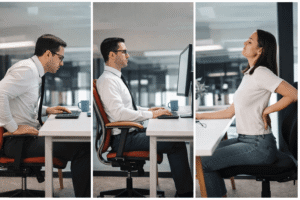
Cardiovascular outcomes are one of the most studied areas in sedentary behavior research. Across multiple long-term datasets, higher sedentary time has been associated with increased risk of heart-related outcomes — including heart failure and cardiovascular death — even among people who also exercise regularly.
Mechanistically, the connection is plausible: prolonged sitting reduces lower-body muscle activity, alters blood flow dynamics, and can worsen post-meal metabolic responses when sitting dominates the day. Over years, these subtle shifts may contribute to vascular stress and cardiometabolic burden.
For a practical, authoritative overview of why sitting is treated as a cardiovascular risk factor, you can review Harvard’s evidence-based discussion of the topic here:
Harvard Health Publishing: the dangers of sitting.
sitting, brain health, and cognitive aging
The brain’s health depends heavily on vascular integrity, stable glucose regulation, and low chronic inflammation — all areas that can be influenced by long-term movement patterns. Emerging research suggests that higher sedentary time may be associated with worse cognitive outcomes in older adults, although this field is still evolving.
One important nuance: not all sitting is equal. Sitting while mentally engaged — reading, learning, social interaction — is different from long, passive screen time. Yet even with cognitive engagement, the body still benefits when mental activity is paired with periodic movement.
From a longevity lens, the smartest approach is not to fear sitting, but to avoid prolonged, unbroken inactivity — especially in later decades, when vascular resilience and metabolic flexibility are more sensitive to daily routines.
can exercise “cancel out” sitting too much
Exercise is one of the most powerful longevity behaviors we know. However, evidence suggests that structured exercise does not always fully erase the physiological effects of sitting for many hours without breaks. Think of exercise and sedentary time as two different dials, not one.
The World Health Organization recommends regular aerobic activity and also emphasizes reducing sedentary time. If you want the primary source guidance, see:
World Health Organization: guidelines on physical activity and sedentary behaviour.
In plain terms:
- exercise supports cardiovascular fitness, muscle, and metabolic health
- movement breaks support healthier glucose and circulation patterns across the day
- the best longevity outcomes tend to appear when both are addressed
how much movement is “enough” to matter
The encouraging part is that meaningful benefits do not require extreme routines. Studies examining sedentary behavior patterns suggest that short, frequent movement breaks can improve post-meal glucose and insulin responses compared with uninterrupted sitting. For many people, the simplest sustainable target is:
- stand up at least once every thirty to sixty minutes
- walk for one to three minutes, or do light movement
- aim for a few brief “movement snacks” across the day
These actions may look small, but they create repeated physiological “wake-up calls” for muscles and circulation — the kind that sedentary routines remove.
how to sit less without turning life upside down
Sitting is not the enemy. The problem is sitting without interruption for hours. The goal is realistic friction — tiny changes that make movement inevitable.
at work or at a desk
- stand during phone calls or short meetings
- set a timer to stand every forty-five minutes
- place your water bottle farther away so you must stand to refill
- consider alternating seated work with short standing blocks
during commuting and errands
- park slightly farther away when safe
- stand and stretch briefly before driving home
- use stairs for one flight when practical
at home in the evening
- break up screen time with short standing “resets”
- do light stretching while a kettle boils or food cooks
- take a short walk after dinner when possible
If you are also working on sleep quality, pairing movement breaks with a consistent sleep routine can be especially helpful. (Related reading on your site: insomnia.)
who should be especially careful
Some people may be more sensitive to the effects of prolonged sitting, especially when combined with low overall activity:
- adults over forty, due to natural shifts in muscle mass and metabolic flexibility
- people with cardiometabolic risk factors (high blood pressure, insulin resistance, elevated triglycerides)
- individuals who work long sedentary hours with few breaks
- people with limited mobility who spend most of the day seated
For a clear, consumer-friendly overview of sedentary lifestyle risks, see:
MedlinePlus: health risks of an inactive lifestyle.
If you have a medical condition, mobility limitation, or recent surgery, it’s wise to personalize changes with a clinician or physiotherapist. Even then, the principle usually holds: safe, frequent, gentle movement tends to help.
the sitting–sleep connection: why inactivity during the day disrupts sleep at night
Sitting and sleep can look unrelated. One happens during the day, the other at night. Yet evidence suggests that low daytime movement may influence sleep quality, particularly in midlife and beyond.
Sleep is partly regulated by sleep pressure — a natural build-up of signals that helps the body feel ready for rest at night. Daytime movement supports that process through muscle activity, energy expenditure, and normal body-temperature rhythms. When most of the day is spent seated with minimal movement, the contrast between “active day” and “restful night” becomes weaker. For some people, that can translate into:
- difficulty falling asleep
- lighter, more fragmented sleep
- feeling unrefreshed despite enough time in bed
Evening sitting often includes screens and artificial light, which can further push the body toward being “tired but wired.” A practical longevity-friendly approach is to build light movement into earlier hours and reduce long passive sitting blocks late at night.
sitting, insulin timing, and evening cravings: the metabolic link few people notice
Evening cravings are often framed as willpower. But metabolism offers a quieter explanation: how you move earlier in the day can influence appetite signals later at night.
Skeletal muscle is one of the body’s primary sites for glucose uptake. When muscles are active, they absorb glucose more efficiently with less insulin. Prolonged sitting reduces muscle contractions for hours at a time, which can worsen post-meal glucose handling. Combine that with a normal circadian pattern — insulin sensitivity tends to be higher earlier in the day and lower in the evening — and some people end up with a more unstable appetite rhythm at night.
In plain terms, long sedentary days may contribute to:
- stronger desire for refined carbohydrates in the evening
- feeling hungry soon after dinner
- a cycle of late snacking that can disrupt sleep
What helps is often surprisingly simple and consistent with research on metabolic timing:
- add light movement after meals when possible
- break up long sitting periods before late afternoon
- use a short post-dinner walk as a steady habit, not a punishment
If you’re also addressing metabolic health, you may want to connect this topic with your evidence-based guide on liver-metabolic risk factors (related reading on your site: fatty liver).
frequently asked questions (evidence-based)
is sitting worse than not exercising
They are different behaviors. Exercise improves fitness and supports many longevity pathways. Prolonged sedentary time influences day-long metabolic and vascular patterns. For best results, address both: exercise regularly and reduce long uninterrupted sitting.
does standing all day solve the problem
Not necessarily. Prolonged standing can cause discomfort and swelling for some people. The healthiest pattern is variety: alternate sitting, standing, and light movement throughout the day.
are short movement breaks really enough to matter
Evidence suggests that breaking up sitting with light activity can improve post-meal glucose and insulin responses compared with uninterrupted sitting. The effect is often small per break, but meaningful when repeated daily for years.
what if i already work out regularly
Keep the workouts — they are protective. Then add the missing piece: frequent movement breaks. Think of it as building “background movement” so your body gets regular muscle and circulation signals outside the gym.
what’s the simplest habit to start with
Choose one trigger and make it automatic: stand up every time you finish a task, stand during phone calls, or walk for one minute every hour. Consistency matters more than intensity.
final takeaway
Sitting too much is not a personal failure. It is the default setting of modern life. What makes it risky is not sitting itself, but how dominant and uninterrupted it has become.
Scientific evidence suggests prolonged sitting is associated with less favorable metabolic and cardiovascular patterns over time, especially after midlife. The solution does not require dramatic changes. It requires frequent, gentle interruptions — small movement moments that restore the body’s natural rhythm.
Move more, sit less, and break up long sitting blocks. That simple combination is one of the most realistic longevity habits you can build — and one of the easiest to underestimate.
Optional internal support reading on your site: if you want an evidence-based nutrition angle that supports healthy movement and muscle maintenance with age, see eggs.