
Balance Exercises for Fall Prevention After 40
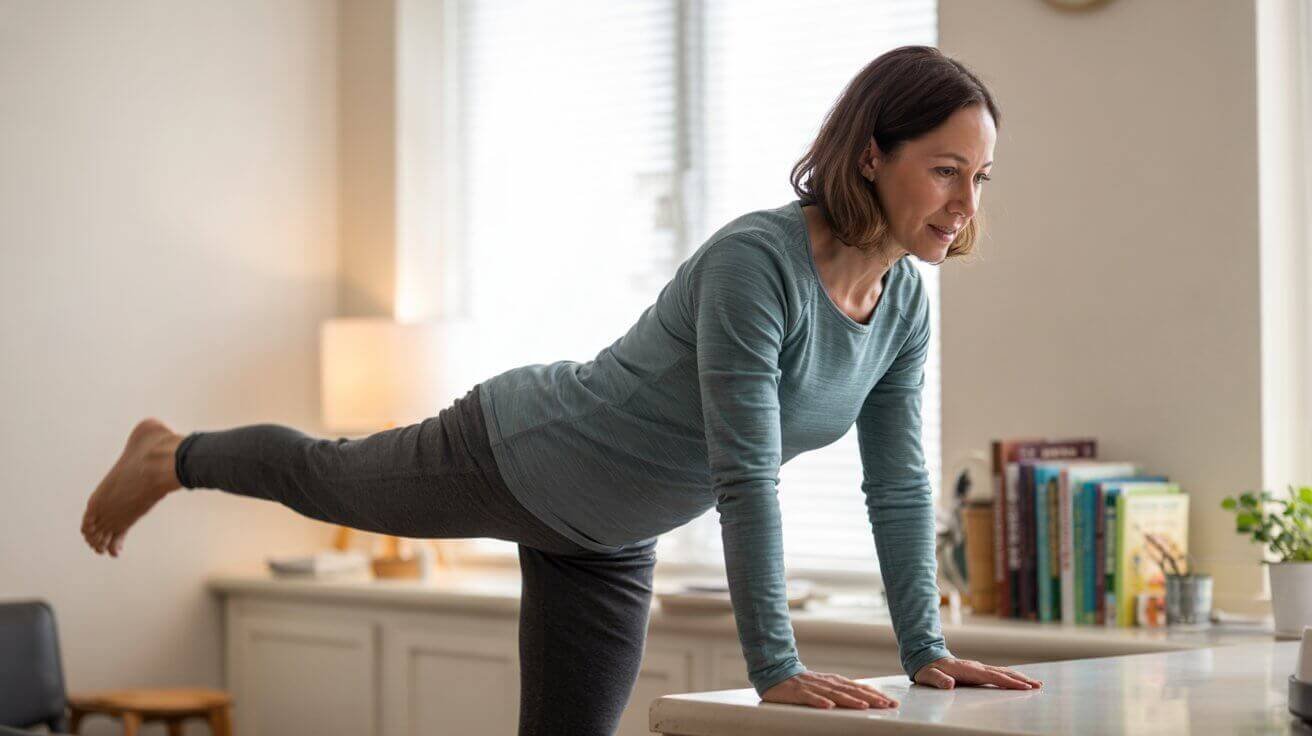
Balance exercises for fall prevention are not “extra” workouts. They’re a practical skill set that helps you stay independent as the years pass. Balance determines how confidently you walk on uneven ground, how safely you step off a curb, how steady you feel carrying groceries, and how quickly you can recover when you trip or turn too fast.
Many adults notice subtle changes after forty: a little more stiffness, a little less ankle mobility, a little less confidence on stairs. None of that means you’re “done.” It often means your balance system needs practice—just like strength and endurance do. The most reassuring part is that balance is trainable at any age, especially when you combine smart balance drills with lower-body strength and simple daily movement.
In this guide, you’ll learn what balance really is (it’s more than “core”), why falls happen, which types of training are best supported by evidence, and how to start safely—even if you haven’t exercised in a while.
why balance is the hidden skill behind independence
Balance is easy to ignore when it’s working. You stand up, turn, walk, and step without thinking. But in real life, stability is constantly challenged:
- a wet floor that changes traction
- a dark hallway at night
- a dog leash that pulls suddenly
- a curb that’s slightly higher than expected
- a quick head turn while walking
In those moments, balance is not about holding a pose. It’s about reacting fast enough, placing the foot accurately, and controlling the joints so your body doesn’t “collapse” into an awkward position.
That’s why fall prevention rarely comes from one single trick. It comes from building a “reserve” of stability: stronger legs, better ankle function, sharper coordination, and a nervous system that has practiced recovery.
If your lifestyle includes long sitting hours, that can quietly dull this reserve over time. Pairing balance work with less sedentary time makes results come faster. You can connect this with our guide on harmful daily habits that undermine healthy aging without obvious symptoms.
what balance actually is (and why “core only” is not enough)
Balance is a teamwork system. Three main inputs feed your brain the information it needs to keep you upright:
- vision: what you see (edges, movement, depth, lighting)
- inner ear (vestibular system): head position and movement
- proprioception: body-position sensing from your feet, ankles, knees, hips, and spine
Your brain processes these signals and sends a rapid response: tighten this muscle, relax that one, shift the hips, place the foot wider, take a faster step. This is why you can have a “strong core” and still feel unsteady—because the issue may be ankle stiffness, poor single-leg control, or reduced proprioception in the feet.
Balance training, at its best, is simply practice for the nervous system. It teaches the body to interpret signals and respond with control. That’s also why balance work should feel specific and slightly challenging—without feeling dangerous.
why falls happen: the common, realistic reasons
Falls are rarely caused by one thing. They usually come from a stack of small, ordinary factors:
lower-body weakness and reduced power
If your legs can’t produce force quickly, you may not catch yourself in time. This is one reason fall-prevention programs often include lower-body strengthening alongside balance work.
ankle stiffness and foot instability
The ankle is your first line of correction. Limited ankle mobility can reduce your ability to “absorb” and adjust, pushing the stress up to knees and hips.
medications, blood pressure drops, or dehydration
Some people feel lightheaded when standing up quickly. That’s not a balance failure—it’s a circulation issue that still increases fall risk. If this happens frequently, it deserves medical attention.
poor sleep and slower reaction time
Sleep affects attention, coordination, and response speed. If you’re chronically underslept, your body is more likely to misjudge steps and timing. You may find it helpful to explore sleep-focused resources like deep sleep and recovery habits that support steadier movement during the day.
environment and “surprise challenges”
Loose rugs, cluttered hallways, dim lighting, and slippery bathroom floors create problems even for relatively fit people—especially when combined with haste.
nutritional and lifestyle support that makes balance training work better
Balance practice is neurological training, but your lifestyle sets the stage for how well your body adapts. Three fundamentals matter most:
- protein and overall nutrition: to support muscle maintenance and recovery
- hydration: to reduce dizziness risk and support performance
- consistent daily movement: because the nervous system learns faster with frequent exposure
You don’t need perfection. You need repeatability. If you want a simple framework that supports all training goals—strength, balance, and energy—see small lifestyle changes that improve consistency without turning your life upside down.
scientifically supported benefits of balance training
Balance training is widely included in fall-prevention strategies because research and public health guidance consistently highlight its functional value—especially in older adults. When balance work is combined with strength training, benefits tend to be more meaningful for real-world mobility.
fewer stumbles and better “recovery steps”
Evidence suggests that practicing balance tasks improves coordination and the ability to respond to perturbations (small disturbances) like slips or quick turns. Mechanistically, training improves the timing of muscle activation and joint control—especially around the hips and ankles.
better walking confidence and steadier gait
Many people don’t fear falling in a dramatic way. They simply start avoiding movement: fewer walks, fewer outings, fewer stairs. This avoidance can accelerate weakness and stiffness. Balance training often improves confidence, which can help people move more, creating a positive cycle.
support for healthy aging and independence
From an “aging well” standpoint, balance is not a performance goal. It’s a daily-life goal. Strong balance and leg control support the ability to live independently, travel, and stay active into later decades.
what “good” balance training looks like (and what to avoid)
The best balance training is simple, progressive, and safe. It usually includes:
- static balance: holding a position (for example, single-leg stance with support)
- dynamic balance: staying stable while moving (for example, controlled steps, turns, heel-to-toe walking)
- reactive balance: learning to recover when something changes (for example, stepping strategies practiced slowly and safely)
What to avoid early on is anything that turns balance into a “risk.” For most adults, especially after forty or with prior injuries, the smartest approach is to start supported, build control, and gradually reduce support over time.
Safety rule that works: if a drill makes you feel like you might fall, it’s not the right level yet. The right level feels challenging, but controlled.
the balance-first checklist: how to start safely today
Before you do a single drill, set up your environment so training is safer than everyday life:
- train near a wall, sturdy countertop, or heavy chair you can hold lightly
- wear stable shoes or go barefoot only if you feel safe and your surface is non-slip
- keep the room well-lit
- start with short sets (twenty to forty seconds), not “long holds”
- stop if you feel dizzy, lightheaded, or sharply painful
how to train balance for fall prevention (a simple plan that works)
The most reliable approach is not complicated: combine short, frequent balance practice with two strength sessions per week. This matches the way the nervous system learns (through repetition) and the way your body stays resilient (through stronger legs and hips).
Public health guidance for older adults consistently emphasizes a weekly mix of aerobic activity, muscle strengthening, and balance work. CDC guidance for older adults and the World Health Organization’s physical activity guidance both highlight balance and strength as key pieces of healthy aging.
your weekly structure (realistic and repeatable)
- daily balance routine: eight to ten minutes, five to six days per week
- strength training: two days per week (lower body + trunk stability)
- walking or easy cardio: most days, as tolerated
The goal is not to “max out” balance. The goal is to build steady confidence in everyday movement.
the ten-minute daily balance routine (beginner to intermediate)
Do this near a wall, sturdy countertop, or heavy chair. Use fingertip support as needed. The right level feels challenging but controlled.
one: weight shifts (one minute)
Stand tall. Slowly shift weight from left foot to right foot. Keep the hips level. This wakes up proprioception in the feet and ankles.
two: tandem stance or heel-to-toe stand (two minutes)
Place one foot directly in front of the other (like standing on a line). Hold for twenty to thirty seconds, then switch sides. Use support lightly. This narrows your base of support and trains stability where many people feel “wobbly.”
three: heel-to-toe walk (two minutes)
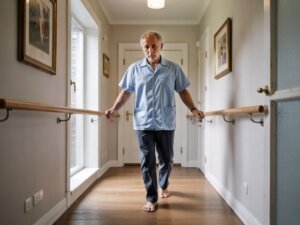
Walk forward placing the heel of one foot directly in front of the toes of the other. Go slowly. Keep eyes forward. If needed, do it alongside a wall. This is a high-transfer drill for steadier walking.
four: single-leg stand (two minutes)
Hold the counter with one or two fingers. Lift one foot slightly. Keep a soft bend in the standing knee. Hold for ten to twenty seconds each side, repeat. Over time, reduce support.
five: controlled stepping (two to three minutes)
Step forward and back with one foot, then switch. Then step sideways and back. Keep steps small and controlled. This trains the stepping strategies that often prevent a stumble from turning into a fall.
If you want a visual reference for gentle balance drills that can be done at home, the NHS has a clear routine list you can mirror safely. NHS balance exercises
reactive balance (the missing piece most people never practice)
Real falls often happen during a “surprise” moment: you trip, you turn quickly, you misjudge a step. Reactive balance training teaches your body to recover with a quick, accurate step.
Keep this safe and controlled. Do not do it if you feel dizzy or unsafe.
the “three-step recovery” drill (two minutes)
- stand near a counter
- take one quick step forward, return
- take one quick step sideways, return
- take one quick step backward, return
Repeat on both sides. The focus is quiet feet, stable hips, and quick control.
strength training that directly supports balance
Balance improves faster when the body has the strength to “use” the balance skill. Weak hips and thighs force compensation, and compensations are unstable. Two sessions per week is enough to create meaningful change.
session a (strength foundation)
- sit-to-stand (chair): three sets of eight to twelve reps
- step-ups (low step): three sets of six to ten reps per side
- hip hinge or glute bridge: three sets of eight to twelve reps
- calf raises: two to three sets of ten to fifteen reps
session b (single-leg control)
- split squat (supported) or assisted lunge: three sets of six to ten reps per side
- side step with band (or slow lateral steps): two to three sets of ten to fifteen reps
- slow step-down (small range): two sets of six to eight reps per side
- carry practice (optional): light farmer carry for posture and stability, two short rounds
Progress rule: add repetitions first, then add a small amount of resistance. Keep movement controlled. If joints get irritated, reduce range of motion, slow the lowering phase, or use more support.
how to progress safely (without turning balance into a risk)
progress by reducing support
Go from two hands → one hand → fingertips → hovering hand. This is one of the safest progressions.
progress by narrowing the base
Feet hip-width → feet together → tandem stance → single-leg stance. Move to the next step only when the current level feels controlled.
progress by adding “real-life” challenges
Once basic drills feel stable, add small head turns while walking, or carry a light object while doing heel-to-toe walking. These mimic real life, where balance is rarely “single-task.”
home and lifestyle upgrades that reduce fall risk immediately
Exercise helps, but the environment matters. A few changes can reduce risk quickly, even before training adaptations show up:
- lighting: brighter hallways and night lighting reduce missteps
- floors: remove loose rugs or use non-slip backing
- bathroom: non-slip mat, secure handholds if needed
- shoes: stable shoes with good grip; avoid slippery socks on smooth floors
- standing up: rise slowly if you get lightheaded
And if you regularly feel dizzy, faint, or unusually unsteady, it’s worth discussing with a clinician—especially if medications changed recently. Sometimes fall risk is more about blood pressure, vision, or medication side effects than “weak balance.”
who should be careful
Balance training is adaptable, but extra caution is wise if you have:
- frequent dizziness or fainting (especially when standing)
- new neurological symptoms (new numbness, sudden weakness, new vision changes)
- significant neuropathy affecting the feet
- recent falls or fear so strong it limits daily movement
- recent surgery or acute injury
In these cases, supported balance work is still often possible, but individualized guidance from a clinician or physical therapist can make the plan safer and more effective.
frequently asked questions (evidence-based)
how often should i do balance exercises for fall prevention?
Most people do best with short practice sessions most days (five to ten minutes), plus two days of strength training. Frequent practice helps the nervous system learn, while strength supports control.
can balance really improve after forty or fifty?
Yes, in many cases. Balance is a trainable skill because it relies on coordination, proprioception, and strength—all of which adapt to practice. Progress is often noticeable within four to eight weeks when training is consistent.
what is the single best balance exercise?
There isn’t one “best.” A mix tends to work best: single-leg practice, heel-to-toe walking, controlled stepping, and lower-body strength. This combination covers the main systems that prevent falls in real life.
i feel unsteady at night. what should i do?
Night unsteadiness is common when lighting is low and you’ve been lying down. Use night lighting, stand up slowly, and keep pathways clear. If you get frequent dizziness or near-fainting, discuss it with a clinician.
is walking enough for fall prevention?
Walking is valuable, but it doesn’t train all balance qualities—especially single-leg stability and reactive stepping. Adding targeted balance drills and strength sessions usually provides better “insurance” for real-life slips and stumbles.
final takeaway
Balance exercises for fall prevention are not about being “fit.” They’re about staying steady, confident, and independent. The most effective approach is simple: practice balance briefly and often, strengthen the legs twice per week, and improve the small home factors that cause preventable slips.
Start supported. Build control. Progress gradually. In a few weeks, many people notice the difference where it matters most: stairs, turns, uneven ground, and that quiet confidence that your body can handle everyday surprises.
Educational note: This content is for general information and does not replace medical advice. If you have frequent dizziness, fainting, new neurological symptoms, severe neuropathy, recent falls, or chest pain with activity, speak with a qualified clinician before starting a new program.