
Leg Strength for Mobility: Stronger Legs After 40

Leg strength exercises are one of the most practical “investments” you can make for long-term mobility. Not because you need to look athletic. But because strong legs quietly decide how easily you get up from a chair, climb stairs, carry groceries, keep your balance on uneven ground, and recover from a misstep before it becomes a fall. In other words, leg strength is strongly tied to independence.
And the good news is this: the decline many people assume is “normal aging” is often more about disuse than destiny. Evidence-based guidelines consistently recommend muscle-strengthening activity for older adults, along with balance-focused movement, because it supports function and helps reduce fall risk. CDC guidance for older adults and the World Health Organization’s physical activity guidance emphasize strength and balance as core pillars of healthy aging.
This article is written for real life: if you’re over forty, busy, maybe stiff in the hips, maybe sitting too much, maybe noticing that stairs feel “louder” in your knees than they used to. We’ll cover what leg strength really is, what science says it helps with, and how to build it safely and consistently.
why leg strength is the quiet foundation of aging well
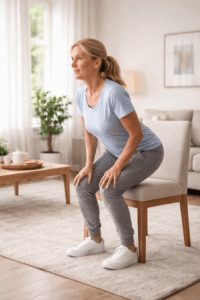
People often think “legs” means quads and calves. But functional leg strength is bigger than a muscle group. It’s your body’s ability to produce force at the right time, through stable joints, with enough coordination to keep you upright and moving confidently.
That matters because everyday tasks are basically mini strength tests:
- Standing up from a chair asks for hip and thigh strength plus core stability.
- Stairs demand single-leg strength, balance, and ankle mobility.
- Preventing a fall often depends on a fast, strong step and good coordination—sometimes in a fraction of a second.
Public health guidelines highlight strength and balance for older adults because falls are a major driver of injury and loss of independence, and improving lower-body capacity is a practical prevention lever. The WHO explicitly recommends that older adults include muscle-strengthening and balance-focused activities to help prevent falls and improve overall health. WHO guidelines
Also, it’s hard to “out-walk” weak legs. Walking is excellent for cardiovascular health and daily movement, but it doesn’t always provide enough progressive stimulus to maintain or rebuild strength—especially if you’ve been sedentary. If you want to connect the dots between long sitting hours and the slow decline in function, see our guide on sedentary habits that quietly undermine longevity.
what is leg strength, and why does it decline with age?
Leg strength is the ability of your lower-body muscles to generate force. But from a mobility standpoint, three related qualities matter:
- strength: how much force you can produce (for example, standing up from a low seat).
- power: how quickly you can produce force (for example, catching yourself when you trip).
- strength endurance: how well you sustain repeated efforts (for example, climbing several flights of stairs).
With age, several factors can chip away at these qualities:
- lower training stimulus: sitting more, moving less, fewer “challenging” movements.
- muscle and nerve changes: age-related shifts in muscle mass and neuromuscular activation can reduce strength and coordination.
- joint stiffness and pain cycles: discomfort leads to avoidance, which leads to more weakness, which can worsen discomfort.
- reduced balance practice: modern life removes many balance challenges (flat floors, supportive shoes, fewer varied surfaces).
Strength training has been studied for decades and is widely discussed as a way to support mobility and function with age. NIA overview
the “leg strength profile”: the muscles and systems that matter most
When people say “I want stronger legs,” they often focus on what they can see in a mirror. But the body systems that keep you mobile are often the ones you don’t notice—until they’re undertrained.
Here’s the practical profile to think about:
hip power and control (glutes + deep hip muscles)
The hips drive walking speed, stair climbing, and rising from chairs. Strong glutes also help align the knees and reduce “collapse inward” during movement—especially important if you feel unstable on one leg.
knee extension strength (quadriceps)
The quads are heavily involved in standing up, stairs, and deceleration (like stepping down off a curb). If quads are weak, people often compensate by leaning forward, using arms, or stressing the knees.
posterior chain support (hamstrings + calves)
Hamstrings support hip extension and knee stability. Calves (and the ankle complex) help with push-off and balance corrections. In many real-life stumbles, the ability to take a quick stabilizing step depends on this chain working smoothly.
ankle mobility + foot stability
Stiff ankles reduce your ability to absorb force and keep balance, which can increase compensations up the chain—knees and hips often pay the price.
balance systems and proprioception
Balance is not just “core.” It’s vision, inner ear function, and body-position sensing working together. Guidelines commonly pair strength work with balance training for older adults because the combination supports safer mobility. CDC older adult activity guidance
This “profile” is why the best programs don’t just chase one exercise. They build a base: stronger hips, better knee control, more capable ankles, and regular balance practice.
health benefits supported by studies
Leg strength is not a magic pill. But multiple lines of research and public health guidance connect strength training—especially lower-body strength and balance work—to meaningful outcomes in function and health. Below are benefits commonly supported by studies, with the underlying “why” explained in plain language.
mobility and fall risk
Stronger legs can improve how well you handle daily tasks (stairs, chair rises, walking on uneven surfaces). In older adults, structured strength training interventions have been studied for fall prevention, often showing improvements in strength, function, and balance-related outcomes. Systematic review on strength training and falls (PMC)
Mechanism (simple): better leg strength and power help you generate a stabilizing step faster; stronger muscles support joints; and training often improves coordination and confidence, which can reduce cautious, unstable movement patterns.
metabolic health and blood sugar support
Muscle tissue is a major site for glucose uptake. When you build or preserve muscle through strength training, your body often becomes better at using glucose, especially when paired with regular movement across the week.
Mechanism (simple): working large muscles (like the legs) creates an “energy demand signal” that can improve insulin sensitivity and glucose handling over time—especially when sessions are consistent and progressive.
If you want the lifestyle angle without overwhelm, see our practical guide on small lifestyle changes that support longevity—because leg strength improves fastest when the rest of the week supports it (movement breaks, sleep, protein, and consistency).
heart and circulation support
Strength training is not a replacement for aerobic exercise, but it can complement heart health by improving overall fitness and making everyday movement easier—so you naturally walk more, climb more stairs, and sit less. The CDC’s older adult guidance recommends both aerobic activity and muscle-strengthening activities as part of a balanced week. CDC older adult activity guidance
Mechanism (simple): stronger legs reduce the “cost” of movement, which can make you more active overall; improved muscle function also supports better metabolic markers that are linked with cardiovascular risk.
brain, mood, and confidence in movement
Many people underestimate the mental side of leg strength: when you trust your legs, you move more. When you move more, sleep, stress management, and mood often improve.
Mechanism (simple): resistance training challenges the nervous system, improves coordination, and can increase self-efficacy (your belief you can do the task). That reduces fear of movement, which is a real barrier to staying active.
longevity and quality of life
Longevity is not only about years—it’s about years with function. Strength training is repeatedly emphasized in public health guidance because it supports the ability to do daily activities and maintain independence across decades. WHO guidelines
Mechanism (simple): stronger muscles support joints and posture, help maintain mobility, reduce frailty risk, and make it easier to stay physically active—creating a positive feedback loop.
how to build leg strength safely (the essential principles)
Before you choose exercises and a weekly plan, lock in the principles that make progress safer and more predictable—especially if you’re coming back after a long period of sitting or have occasional knee, hip, or back discomfort.
principle one: progressive beats perfect
Your body adapts to what you repeatedly ask it to do. You don’t need extreme workouts. You need a plan that gradually increases challenge—slightly more resistance, slightly more control, or slightly more range of motion over time.
principle two: train the pattern you want in real life
Most daily tasks come down to a few patterns: sitting-to-standing, stepping up, stepping down, and stabilizing on one leg. A smart program trains these patterns directly and safely.
principle three: pain is information, not a dare
Mild muscle effort and “work” are normal. Sharp joint pain, numbness, or pain that worsens after training is a sign to scale down, adjust technique, or seek individualized guidance—especially if you have a history of injury or medical conditions.
principle four: strength plus balance is the combination most people miss
Strength alone doesn’t guarantee stability. Balance is a trainable skill, and it improves fastest with frequent, small practice doses. CDC guidance
the most effective leg strength exercises for mobility
You don’t need dozens of movements. You need a small set that trains the patterns your body uses every day: stand up, step up, step down, and stabilize on one leg. Below are the best options, with both home and gym variations.
sit-to-stand (chair squat pattern)
Why it matters: this is the “get up from life” skill. If standing from a chair is hard, everything else gets harder.
- home: sit-to-stand from a chair (use hands on thighs if needed).
- progressions: lower chair height, slower lowering, add a backpack for load.
- gym: goblet squat to a box, leg press (range you can control).
step-ups (stair strength and balance)
Why it matters: stairs are single-leg work disguised as daily life. Step-ups train strength plus balance in a very practical way.
- home: step-ups on a stable step; hold a railing lightly for balance.
- progressions: higher step, slower lowering, add light dumbbells.
- gym: weighted step-ups or split squats with support.
hip hinge (glute and hamstring strength)
Why it matters: strong hips protect the knees and back. Many people who feel “knee-dominant” benefit from rebuilding hip strength.
- home: hip hinge practice (hands on hips), glute bridge, Romanian deadlift with a backpack.
- gym: Romanian deadlift, cable pull-through, hip thrust.
calf raises (ankle strength and stability)
Why it matters: the calf-ankle complex helps with push-off, balance corrections, and steady walking speed.
- home: standing calf raises holding a wall; progress to single-leg calf raises.
- gym: calf raise machine or smith machine calf raises.
single-leg stability (balance that transfers)
Why it matters: walking is a sequence of single-leg stands. Training balance improves confidence and control.
- simple options: supported single-leg stand, tandem stance (heel-to-toe), slow marching in place.
- progressions: reduce hand support, turn the head slowly, or close the eyes only if safe.
how much training is “enough” for stronger legs?
Most people do best with a simple target: two to three strength sessions per week focused on the lower body, plus short balance practice most days. This aligns with public guidance that older adults should include muscle-strengthening activity and balance-focused work across the week. CDC older adult activity guidance
Here’s a practical framework:
- strength sessions: two or three days per week (twenty to forty minutes).
- sets and reps: two to four sets of six to twelve controlled reps per exercise.
- effort level: finish most sets feeling like you could do about two to three more reps with good form.
- balance: five to eight minutes, four to six days per week.
- walking: keep it in, but don’t rely on it as your only “leg training.”
a simple leg strength plan (home or gym)
This is a realistic template. Choose one option from each category. Start easier than you think you need. Consistency beats intensity.
session a (strength plus stability)
- sit-to-stand or box squat: three sets of eight to twelve reps
- step-ups (low step): three sets of six to ten reps per side
- glute bridge or hip hinge: three sets of eight to twelve reps
- calf raises: two to three sets of ten to fifteen reps
- balance finisher: two rounds of thirty to forty-five seconds supported single-leg stand per side
session b (strength plus knee-friendly control)
- split squat (supported) or leg press: three sets of six to ten reps per side
- Romanian deadlift (light) or hip thrust: three sets of eight to twelve reps
- side step with band or lateral step-down (small range): two to three sets of eight to twelve reps
- calf raises: two to three sets of ten to fifteen reps
- balance finisher: tandem walk (heel-to-toe) for two to three slow passes
Weekly example: session a on Monday, session b on Thursday, and optional light “technique day” on Saturday (one or two exercises plus balance). On non-strength days, short walks are great. If you’ve been sitting a lot, pair training with habit changes that reduce total sedentary time. See: sedentary habits that quietly undermine longevity and small lifestyle changes that support longevity.
If sleep is a challenge, improving daily movement and training consistency can support recovery routines. You can explore Sleep & Recovery resources like nighttime habits that support better rest.
how to progress without hurting your joints
Progress is not only “heavier weights.” You can progress in joint-friendly ways.
add reps first
Stay at the same load and add one or two reps per set each week until you reach the top of your rep range, then increase load slightly.
slow the lowering phase
Try a three-second controlled lowering on squats or step-downs. This often builds strength with less irritation than rushed reps.
increase range of motion gradually
If deep knee bend hurts, start with a higher chair or smaller step. As control improves, lower the chair height or raise the step a little.
reduce support over time
For balance work, keep one finger on a wall or countertop at first. Over weeks, use less support.
common form cues that protect the knees and back
- stand tall through the chest: avoid collapsing forward when standing up.
- knees track over toes: a little forward travel is normal; sharp pain is not.
- push the floor away: think “drive through the whole foot,” not just the toes.
- move quietly: smooth reps usually mean better control than noisy, rushed reps.
who should be careful
Leg strength training is generally scalable, but some situations need extra caution or professional guidance:
- recent surgery or acute injury: follow your clinician’s plan for load and range.
- unexplained swelling, locking, or giving way of a joint: get evaluated before pushing intensity.
- severe osteoporosis or fracture risk: emphasize controlled strength work and balance, avoid fast, uncontrolled movements.
- uncontrolled blood pressure or heart symptoms with exertion: check in with a clinician before starting a new program.
- neuropathy, vertigo, or significant balance issues: prioritize supported balance work and a safe environment.
frequently asked questions (evidence-based)
how long does it take to feel stronger legs?
Many people notice better confidence, steadier stairs, or easier chair stands within four to eight weeks if they train consistently. Visible muscle changes may take longer, but functional improvements often come earlier because the nervous system gets better at recruiting muscle.
are squats bad for the knees after forty?
Not automatically. For many people, squats (or sit-to-stands) are a practical way to build strength. The key is choosing a range of motion you can control, progressing gradually, and avoiding sharp pain. If knee discomfort flares, try a higher chair, slower lowering, or shift some work toward hip hinges and step-ups with support.
what if i only have ten minutes a day?
Ten minutes can still work if you’re strategic. Do one main strength pattern (sit-to-stand or step-ups) plus a short balance block. Over a week, those “micro sessions” can add up—especially if you keep them consistent.
is walking enough to maintain leg strength?
Walking is excellent for health, but it doesn’t always provide progressive resistance. If your goal is stronger legs for mobility, add targeted strength work two or three times per week. Walking then becomes even easier because your legs have more “reserve.”
what is the best exercise for preventing falls?
There isn’t one best exercise. Programs that combine lower-body strength with balance training tend to be most practical. A scientific review discusses strength training approaches used in fall prevention research. Systematic review on strength training and falls (PMC)
final takeaway
Leg strength for mobility is less about fitness trends and more about protecting your independence. Stronger hips, thighs, and calves make daily tasks easier, improve balance, and help you move with confidence—especially after forty, when “use it or lose it” becomes more visible.
Keep it simple: train legs two or three times per week, practice balance in small doses, and progress gradually. If you’ve been sitting a lot, start easy and build steadily. Over time, your legs become more reliable—and that reliability shows up everywhere: stairs, walks, posture, and the calm feeling that your body can handle real life.
Educational note: This content is for general information and is not medical advice. If you have significant pain, recent surgery, severe balance issues, or symptoms with exertion, consider consulting a qualified clinician or physical therapist.